
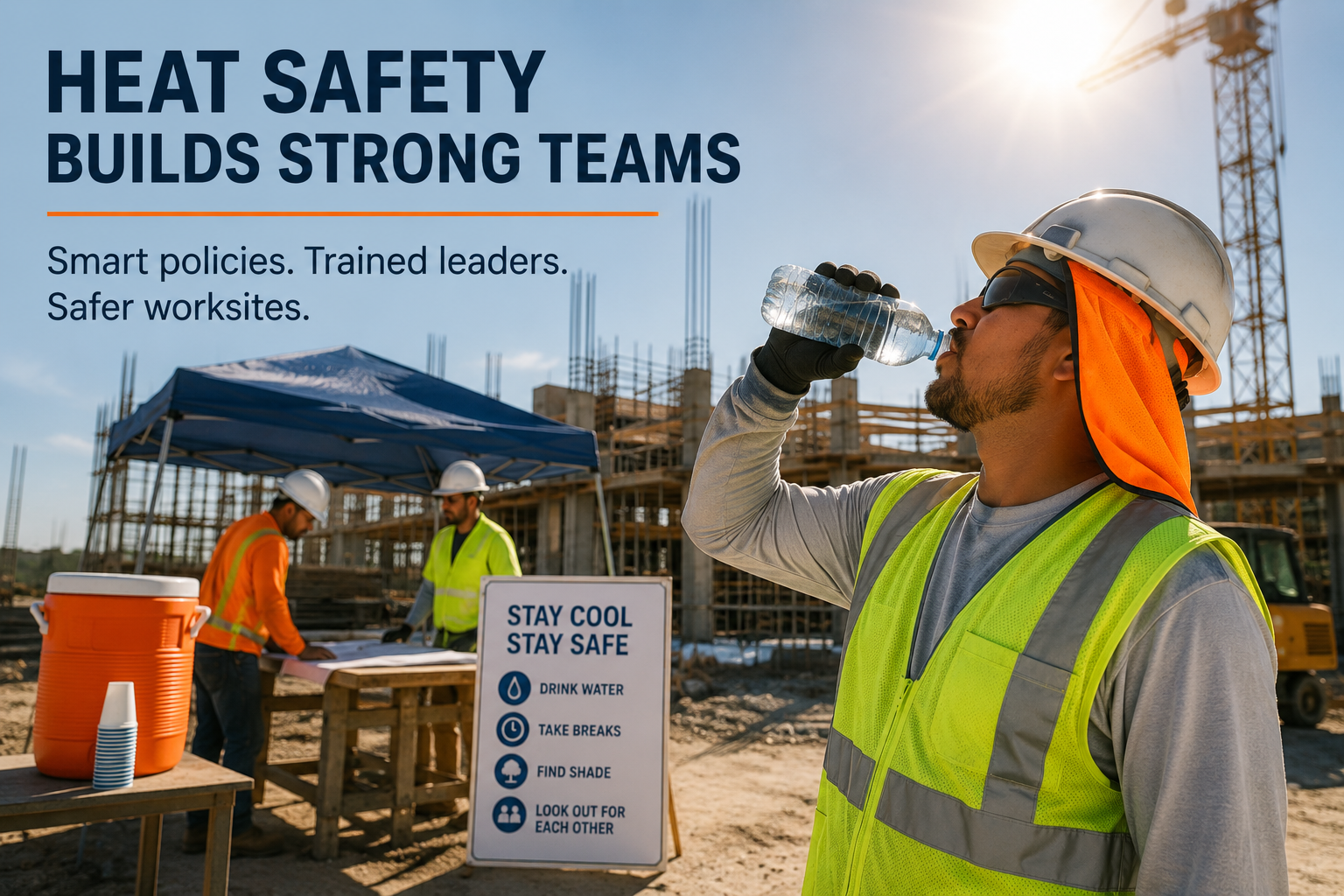
For construction employers, extreme heat is no longer just a summer productivity problem. It is a workforce safety, HR compliance, training, and operational risk that deserves a formal response.
That issue is particularly timely in 2026. OSHA updated its National Emphasis Program for outdoor and indoor heat-related hazards in April 2026, directing inspection and outreach resources toward industries and workplaces where heat risks are most likely to occur. Construction is an obvious area of concern because employees frequently perform physically demanding work outdoors, wear protective equipment, and have limited access to climate-controlled environments.
For small and mid-sized contractors, the challenge is practical: Do your supervisors know what to do when temperatures climb, and can your company demonstrate that it has taken reasonable steps to protect employees?
A strong heat illness prevention program can help protect employees while also reducing operational disruption and strengthening your overall HR and safety practices.
Why Heat Safety Is an HR Issue, Not Just a Safety Issue
Heat exposure may initially look like something that belongs entirely to the safety department. In reality, many of the controls required to manage the risk involve HR.
Consider what happens when a construction company develops a heat prevention program. Someone needs to establish policies, communicate expectations, train supervisors, onboard new employees, document training, address employee concerns, maintain records, and ensure managers apply the procedures consistently.
Those are HR functions.
The consequences of getting them wrong can extend beyond a safety incident. A poorly managed heat program can contribute to absenteeism, turnover, workers’ compensation issues, employee relations problems, lost productivity, and compliance exposure.
This makes coordination between operations, safety leadership, supervisors, and HR especially important.
OSHA Increased Its Heat Enforcement Focus in 2026
On April 10, 2026, the U.S. Department of Labor announced an updated OSHA National Emphasis Program addressing indoor and outdoor heat-related hazards.
The revised program uses OSHA and Bureau of Labor Statistics data from 2022 through 2025 to focus inspection priorities on 55 high-risk industries.
Construction employers should pay attention.
OSHA also explains that employers have responsibilities under the Occupational Safety and Health Act’s General Duty Clause when recognized heat hazards are likely to cause death or serious physical harm and feasible methods exist to address those hazards.
Importantly, employers should avoid treating one temperature as a universal dividing line between “safe” and “unsafe.” Heat risk can depend on humidity, direct sunlight, workload, protective clothing, employee acclimatization, and other workplace conditions.
The practical HR lesson is straightforward: waiting until an employee becomes ill is not a heat safety strategy.
What Should a Construction Heat Illness Prevention Program Include?
A program should reflect the company’s actual jobsites and workforce rather than simply copying a generic policy from the internet.
Several areas deserve particular attention.
1. A Plan for Water, Rest, and Cooling
Employees working in hot conditions need reasonable access to drinking water and opportunities to recover from heat exposure.
Depending on the worksite, controls can include shaded or air-conditioned recovery areas, adjusted break schedules, cooling equipment, and changes to how physically demanding work is scheduled.
OSHA recommends considering engineering and administrative controls such as cooler break areas, scheduling work during cooler portions of the day, reducing physical demands where feasible, and increasing rest periods as heat stress rises.
The important HR component is consistency.
A written policy accomplishes little if a superintendent or foreman discourages employees from taking authorized heat-related breaks because a project is behind schedule.
2. Acclimatization for New and Returning Workers
One frequently overlooked risk involves employees who have not yet adapted to working in hot conditions.
That can include:
- Newly hired employees
- Temporary workers
- Employees returning from an extended absence
- Workers transferred from cooler environments
- Employees experiencing a sudden increase in heat exposure
OSHA recommends gradually increasing exposure for workers who are new to warm environments. Employers should consider how acclimatization procedures fit into onboarding and supervisor training.
For HR, that means heat safety should begin before the employee’s first hot day on the job.
3. Supervisor Training
Your written policy will only be as effective as the supervisors implementing it.
Foremen, superintendents, project managers, and crew leaders should understand your company’s procedures and know how to recognize potential signs of heat-related illness.
Training should also address what supervisors should do when an employee reports symptoms.
Employees should not have to decide between reporting a safety concern and appearing “tough enough” for the job. Leadership behavior plays an enormous role in whether workers actually use the protections a company establishes.
4. Emergency Response Procedures
Construction companies should determine in advance how they will respond when a worker shows signs of a potentially serious heat-related illness.
Questions to address include:
Who contacts emergency medical services?
Who is trained to provide first aid?
How will emergency responders locate the employee on a large or changing jobsite?
Who meets emergency personnel at the entrance?
How are incidents reported internally?
Who documents what occurred?
OSHA recommends that employers have an emergency plan addressing heat-related illness and ensuring medical services are available when needed.
Trying to answer these questions for the first time during an emergency creates unnecessary risk.
Don’t Forget Your Subcontractors and Temporary Workforce
Construction creates an additional HR challenge because several employers may operate on the same project.
General contractors, subcontractors, staffing companies, temporary labor providers, and specialty trades may all have workers at the same site.
That makes communication critical.
Companies should clearly establish responsibilities for orientation, safety expectations, reporting procedures, and coordination among employers. Contractors should also review their contractual arrangements and applicable regulatory obligations rather than assuming another company is handling the issue.
The goal is to prevent gaps where everyone believes someone else trained the worker.
Document What You’re Doing
Documentation does not replace an effective safety program, but it helps demonstrate that the program actually exists.
Construction employers should consider maintaining appropriate records of:
- Heat safety policies and procedures
- Employee training
- Supervisor training
- New-hire orientation
- Site-specific safety communications
- Toolbox talks
- Reported incidents and responses
- Corrective actions
- Policy updates
The HR department can play an important role in creating a repeatable process so documentation does not disappear across jobsites, supervisors, and projects.
Heat Safety Can Affect Employee Retention
There is also a recruiting and retention reason to take this issue seriously.
Construction continues to face a difficult labor market. A 2026 construction HR survey from Arcoro reported that 73% of respondents identified finding the right employees as their top workforce challenge, while retention, worker engagement, leadership development, and compliance were also significant concerns.
At the same time, ADP’s 2026 analysis of construction HR trends points to continuing labor shortages and a workforce whose expectations are changing.
In that environment, employees notice how companies treat people in difficult working conditions.
A contractor that communicates clearly, equips supervisors properly, takes legitimate safety concerns seriously, and applies policies consistently can strengthen trust with employees.
That trust matters when skilled workers have options.
Five Questions Construction Leaders Should Ask Now
Before the next stretch of extreme heat, sit down with HR, operations, and safety leadership and ask:
- Do we have a written heat illness prevention process appropriate for our worksites?
- Are new and returning workers addressed in our acclimatization procedures?
- Have our foremen and supervisors been trained on their responsibilities?
- Can employees report heat symptoms or concerns without being discouraged from doing so?
- Can we produce documentation showing what training and preventive measures we have implemented?
If leadership cannot confidently answer those questions, there is work to do.
Construction HR Compliance Is Becoming More Complex
Heat exposure is only one of the workforce issues contractors are managing in 2026.
Construction companies are simultaneously dealing with skilled labor shortages, rising labor costs, worker classification questions, wage-and-hour requirements, multistate operations, immigration-related workforce uncertainty, safety requirements, and changing employee expectations.
For a smaller contractor without a full internal HR department, keeping up can become a job of its own.
The solution does not have to be building a large corporate HR department.
It does require putting practical systems in place before a workforce issue becomes a business problem.
Build the Project. Don’t Let HR Risk Build With It.
Your company knows how to manage schedules, crews, subcontractors, materials, and deadlines. Your people systems deserve the same level of attention.
Targeted HR helps small and mid-sized construction businesses develop practical HR processes that support compliance, hiring, retention, employee relations, supervisor development, and sustainable growth.
If you’re unsure whether your current policies, training, documentation, or HR practices are keeping pace with your business, now is a good time to find out.
Book a consultation with Targeted HR at www.Targeted-HR.com.
We’ll help you identify the HR gaps that need attention so you can spend more time building your business—and less time reacting to preventable people problems.