
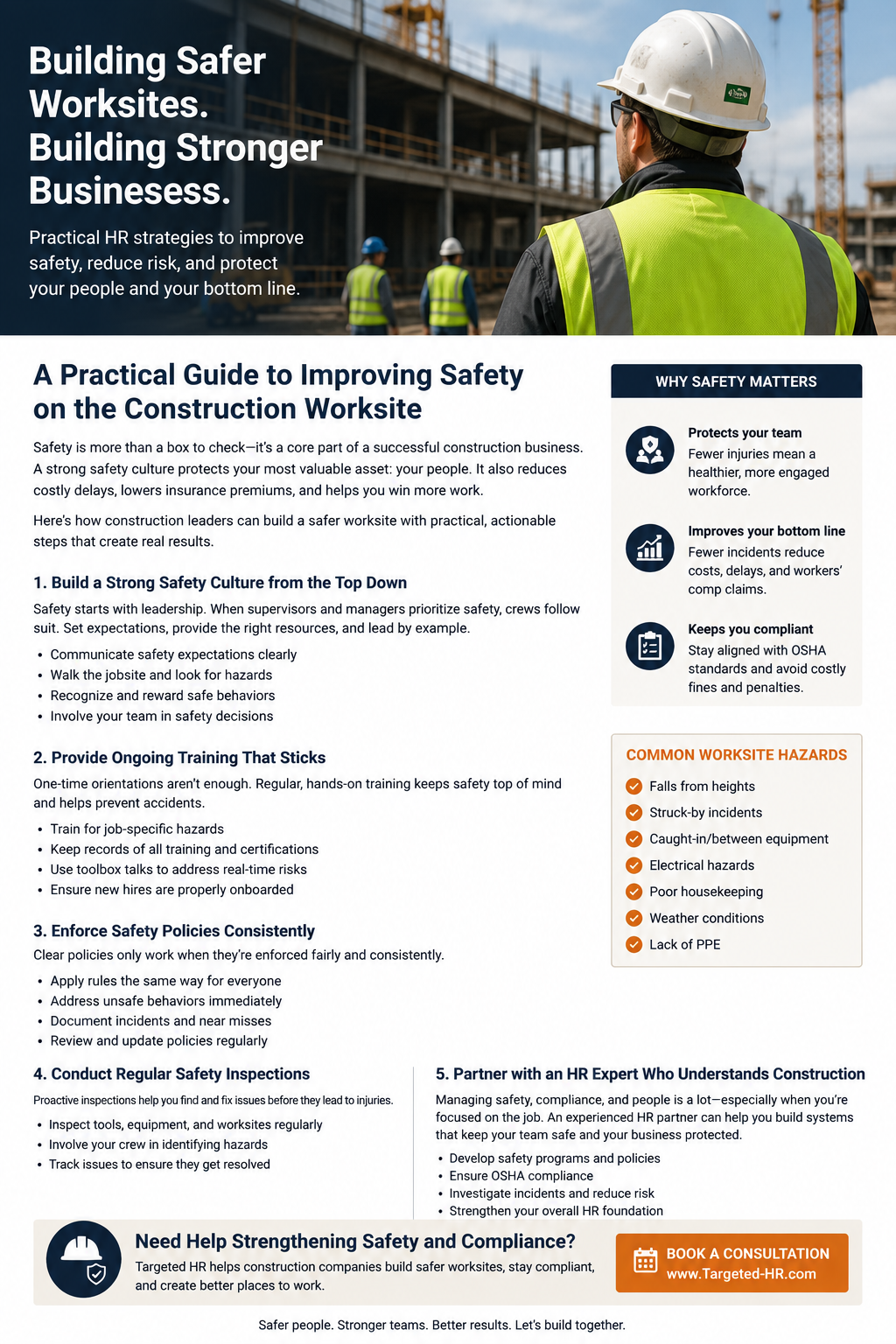
Construction is an industry where safety cannot be treated as an afterthought. Every day, employees work around heavy equipment, elevated surfaces, electrical systems, moving vehicles, power tools, and constantly changing jobsite conditions.
For construction business owners, protecting employees is both a safety responsibility and an important part of running a successful company. A serious workplace incident can affect far more than the employee involved. It can lead to lost productivity, project delays, workers’ compensation claims, increased costs, employee turnover, and potential regulatory issues.
That is why effective construction worksite safety requires more than personal protective equipment and a safety manual. It requires a workplace culture in which leaders, supervisors, and employees understand expectations and consistently put them into practice.
Here are practical ways construction companies can strengthen safety while building a more accountable and productive workforce.
1. Build a Safety Culture From the Top Down
A strong safety culture starts with leadership.
Employees quickly notice whether managers take safety requirements seriously. If supervisors ignore unsafe behavior to finish a project faster, employees may conclude that production matters more than following established safety procedures.
Construction leaders should make safety expectations clear and consistently demonstrate them.
That can include:
- Discussing safety during regular meetings
- Following required safety procedures when visiting job sites
- Giving supervisors authority to stop and address unsafe work
- Recognizing employees who demonstrate good safety practices
- Encouraging employees to report hazards and near misses
- Correcting unsafe behavior consistently
Safety should be part of how the company operates—not just something discussed after an accident.
2. Identify Hazards Before Work Begins
Construction worksites can change rapidly. New contractors arrive, equipment moves, weather conditions change, and the hazards present in the morning may be different by the afternoon.
Regular hazard assessments can help supervisors identify problems before they result in injuries.
Depending on the type of work being performed, potential hazards may include:
- Falls from elevated surfaces
- Struck-by hazards
- Caught-in or caught-between hazards
- Electrical hazards
- Improper use of tools or equipment
- Inadequate personal protective equipment
- Poor housekeeping
- Vehicle and equipment traffic
- Weather-related hazards
- Improper lifting or material handling
Supervisors should also encourage employees to participate in identifying hazards. The employees performing the work often have valuable insight into changing jobsite conditions.
3. Make Construction Safety Training Ongoing
New-hire orientation is important, but effective construction safety training should not end after an employee’s first day.
Training should be appropriate to the employee’s responsibilities and the hazards associated with the work. Employers should also consider refresher training when job duties, equipment, procedures, or worksite conditions change.
Short toolbox talks can be especially useful. Instead of relying exclusively on lengthy annual meetings, supervisors can regularly address specific hazards crews are likely to encounter.
Topics might include fall prevention, ladder safety, PPE, heat exposure, equipment operation, housekeeping, electrical hazards, or reporting procedures.
Employers should maintain appropriate documentation of required training, including dates, topics, and employee participation.
4. Create Clear Safety Policies—and Enforce Them Consistently
A written safety policy has limited value if employees do not understand it or supervisors do not enforce it.
Policies should clearly communicate expectations and explain what employees should do when they identify unsafe conditions.
Just as importantly, supervisors need to apply workplace rules consistently.
When one employee is disciplined for violating a safety rule while another employee’s similar behavior is ignored, the company can undermine both accountability and employee trust.
Construction companies should periodically review their safety and HR policies to ensure they continue to reflect current operations, job responsibilities, and applicable requirements.
5. Encourage Employees to Report Near Misses
Not every safety problem results in an injury.
Sometimes an employee slips but catches themselves. A piece of material falls without striking anyone. Equipment nearly collides with a worker or vehicle.
These near misses can provide valuable information.
Instead of ignoring near misses when no one was injured, employers should view them as an opportunity to identify and correct hazards before a more serious incident occurs.
Create a straightforward reporting process and make sure supervisors know how to respond. Employees should feel comfortable raising legitimate safety concerns without being discouraged from speaking up.
6. Give Supervisors the Right Training
Frontline supervisors play an essential role in workplace safety in construction.
They are often responsible for communicating expectations, observing employee behavior, correcting problems, documenting incidents, and determining when an issue needs to be escalated.
However, being an experienced construction professional does not automatically make someone an effective people manager.
Supervisor development should address topics such as:
Communicating Expectations
Supervisors should know how to clearly explain both performance and safety requirements.
Correcting Unsafe Behavior
Managers need a consistent process for addressing violations without ignoring problems or reacting unpredictably.
Documentation
Supervisors should understand when and how workplace incidents, coaching conversations, disciplinary actions, and other employment matters should be documented.
Escalation
Managers also need to recognize situations requiring assistance from company leadership, HR professionals, safety professionals, or other appropriate resources.
Investing in supervisors can strengthen both safety and overall workforce management.
7. Prepare for Workplace Incidents Before They Happen
Even companies with strong safety programs need a process for responding when an incident occurs.
Before an emergency happens, determine who is responsible for key actions.
Depending on the circumstances, this could include obtaining emergency assistance, securing the area, notifying appropriate personnel, documenting relevant facts, completing required reports, investigating the incident, and implementing corrective measures.
After an incident, look beyond the immediate event.
Was additional training needed? Was a procedure unclear? Was equipment being used improperly? Did supervision contribute to the problem? Was there a hazard that should have been identified earlier?
The purpose of reviewing an incident should be to understand what happened and reduce the likelihood of recurrence.
8. Keep Safety and HR Working Together
Construction safety is often viewed exclusively as an operations issue, but many safety challenges overlap with human resources.
Consider situations involving:
- Employee training records
- New-hire onboarding
- Job descriptions
- Supervisor accountability
- Disciplinary procedures
- Incident documentation
- Return-to-work practices
- Employee complaints
- Policy communication
- Recordkeeping
When HR, safety, and operations function separately, important information can fall through the cracks.
Creating consistent processes across these areas can help construction companies build stronger systems and reduce unnecessary risk.
9. Review Your Safety Practices Regularly
A growing construction company rarely stays the same.
You may add employees, supervisors, equipment, locations, services, or larger projects. Those changes can introduce new workforce and safety challenges.
Periodically evaluate questions such as:
- Are employees receiving appropriate training?
- Are required records organized and accessible?
- Do supervisors understand company policies?
- Are safety rules consistently enforced?
- Are near misses being reported and reviewed?
- Are new employees properly onboarded?
- Have job responsibilities changed?
- Are workplace policies still appropriate for current operations?
Employers should also stay informed about applicable federal, state, and local requirements and consult qualified safety, HR, or legal professionals when necessary.
Safer Work Sites Can Support a Stronger Construction Business
Strong construction worksite safety practices do more than help prevent injuries. They can contribute to better communication, stronger accountability, improved employee confidence, and a more professional operation.
For small and mid-sized construction companies, however, maintaining effective HR and safety-related processes can become difficult as the business grows.
That is where the right HR support can make a difference.
Targeted HR helps construction companies strengthen their HR foundation, improve workforce practices, develop supervisors, and create practical processes that support safer and more compliant workplaces.
If your construction company needs help reviewing HR policies, strengthening onboarding and training, improving documentation, or supporting your supervisors, schedule a consultation with Targeted HR.