
The Importance of an ATS and HRIS Built by an HR Professional
Technology should support your people—not force your team to work around the software.
As businesses grow, managing employees, hiring qualified candidates, maintaining compliance, and tracking employee data become increasingly complex. While there are countless Applicant Tracking Systems (ATS) and Human Resource Information Systems (HRIS) available today, not all platforms are designed with the realities of Human Resources in mind.
Many HR technology solutions are developed by software companies with limited real-world HR experience. While they may offer impressive features, they often overlook the daily challenges HR professionals face. An ATS and HRIS built by experienced HR professionals focuses on practical workflows, compliance, efficiency, and the employee experience—creating technology that truly supports business operations.
What Is an ATS?
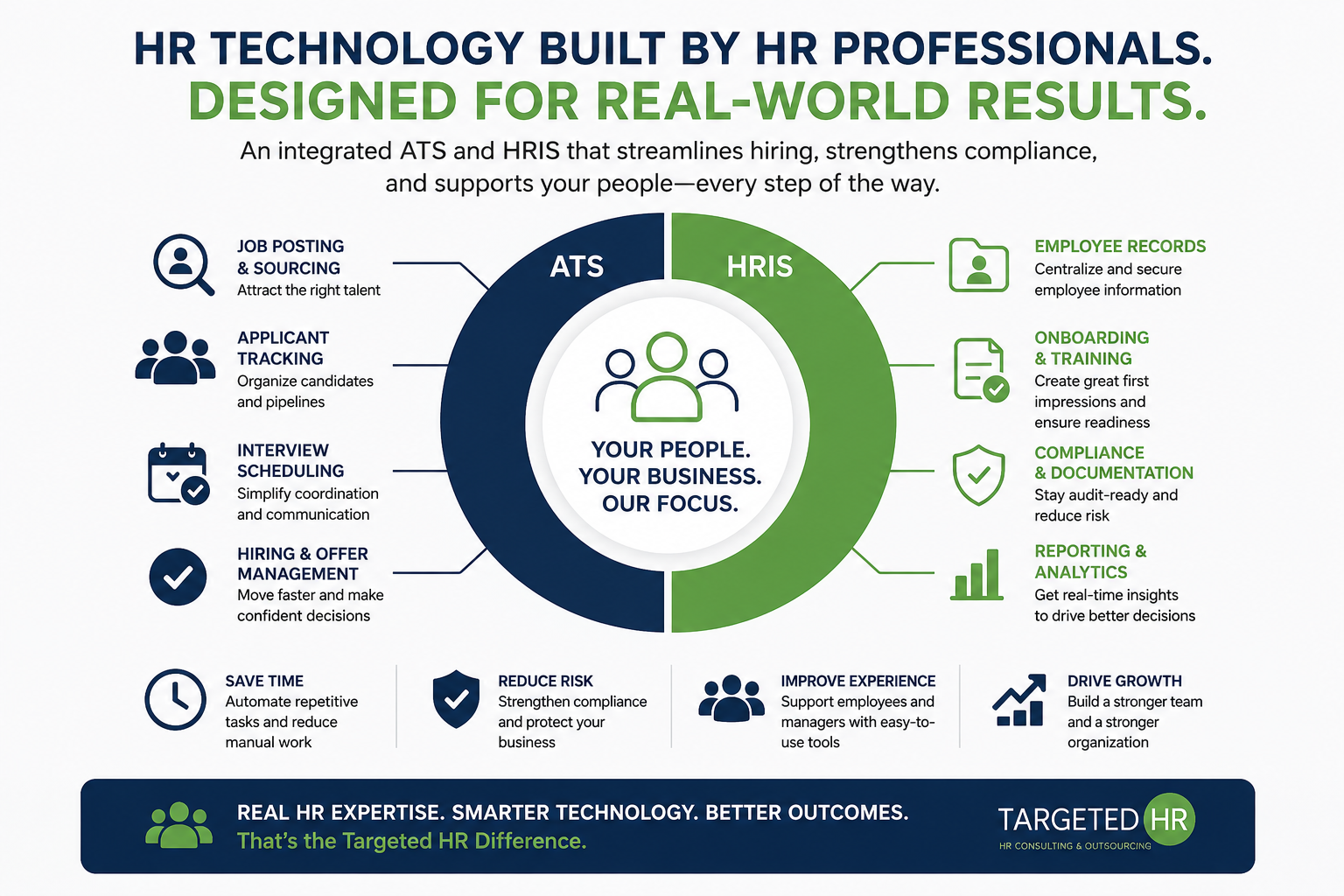
An Applicant Tracking System (ATS) helps organizations manage the recruiting process from job posting through hiring. It centralizes candidate information, automates communication, schedules interviews, tracks applicants, and streamlines hiring workflows.
Key ATS benefits include:
- Faster hiring processes
- Automated candidate communication
- Organized applicant pipelines
- Improved hiring manager collaboration
- Reduced administrative workload
- Enhanced candidate experience
What Is an HRIS?
A Human Resource Information System (HRIS) serves as the central hub for employee information throughout the employee lifecycle. It stores personnel records, manages onboarding, tracks certifications, maintains compliance documentation, supports performance management, and often integrates with payroll and benefits administration.
Common HRIS capabilities include:
- Digital employee files
- Electronic onboarding
- Training and certification tracking
- Performance management
- Policy acknowledgements
- Reporting and workforce analytics
- Compliance documentation
The Difference Between Software Built by Developers and Software Built by HR Professionals
The biggest difference isn’t the technology—it’s the perspective.
HR professionals understand that every hiring decision, policy acknowledgment, onboarding document, and compliance requirement impacts real employees and business operations. They’ve managed difficult employee relations situations, navigated labor laws, handled audits, recruited during labor shortages, and developed leadership teams.
Because of that experience, systems built by HR professionals prioritize workflows that actually make sense.
HR Professionals Build Software Around Real Work
- Simple hiring workflows that reduce bottlenecks
- Onboarding processes employees actually complete
- Compliance reminders before deadlines are missed
- Reports managers actually use
- Documentation that protects employers
- User-friendly interfaces for HR, managers, and employees
Why Construction and Manufacturing Companies Need Specialized HR Technology
Construction and manufacturing organizations have workforce challenges that generic HR software often overlooks. High turnover, skilled labor shortages, multiple job sites, certifications, OSHA compliance, shift scheduling, and decentralized workforces require flexible HR systems built around operational realities.
HR professionals who have supported these industries understand these challenges firsthand. They know the importance of:
- Tracking certifications and licenses
- Managing multiple locations and supervisors
- Monitoring safety training
- Supporting hourly and salaried employees
- Maintaining accurate documentation for audits
- Simplifying recruiting for skilled trades
Benefits of an ATS and HRIS Designed by HR Experts
1. Better Hiring Decisions
Recruiters and hiring managers spend less time on administrative tasks and more time identifying qualified candidates.
2. Stronger Compliance
Built-in reminders, documentation tracking, and audit-ready records reduce organizational risk.
3. Improved Employee Experience
Employees benefit from streamlined onboarding, self-service tools, digital documents, and better communication throughout their employment.
4. Increased Productivity
Automation eliminates repetitive administrative work, allowing HR teams to focus on strategic initiatives.
5. Better Reporting
HR leaders gain real-time visibility into hiring metrics, turnover, compliance status, training completion, and workforce trends.
6. Scalable Growth
As businesses expand, HR systems built by HR professionals scale alongside organizational needs without creating unnecessary complexity.
Technology Should Support HR—Not Replace It
Technology is an incredibly valuable tool, but it cannot replace strategic Human Resources. The most effective ATS and HRIS platforms enhance the work of HR professionals by automating repetitive tasks while preserving the human element that drives employee engagement, leadership development, and organizational culture.
The best systems don’t simply collect data—they help organizations make smarter decisions.
Choose Technology Designed by People Who Understand HR
Investing in an ATS and HRIS is about more than purchasing software. It’s about choosing a system that supports compliance, strengthens hiring, improves employee experiences, and helps your organization grow.
When HR technology is built by professionals who have lived the challenges of recruiting, employee relations, compliance, onboarding, and workforce management, every feature serves a practical purpose.
Technology should adapt to your HR processes—not force your HR team to adapt to the technology.
Partner with Targeted HR
At Targeted HR, we understand that successful HR technology starts with practical HR expertise. Our solutions are designed to help construction and manufacturing businesses streamline hiring, strengthen compliance, improve employee management, and build scalable HR processes that support long-term growth.